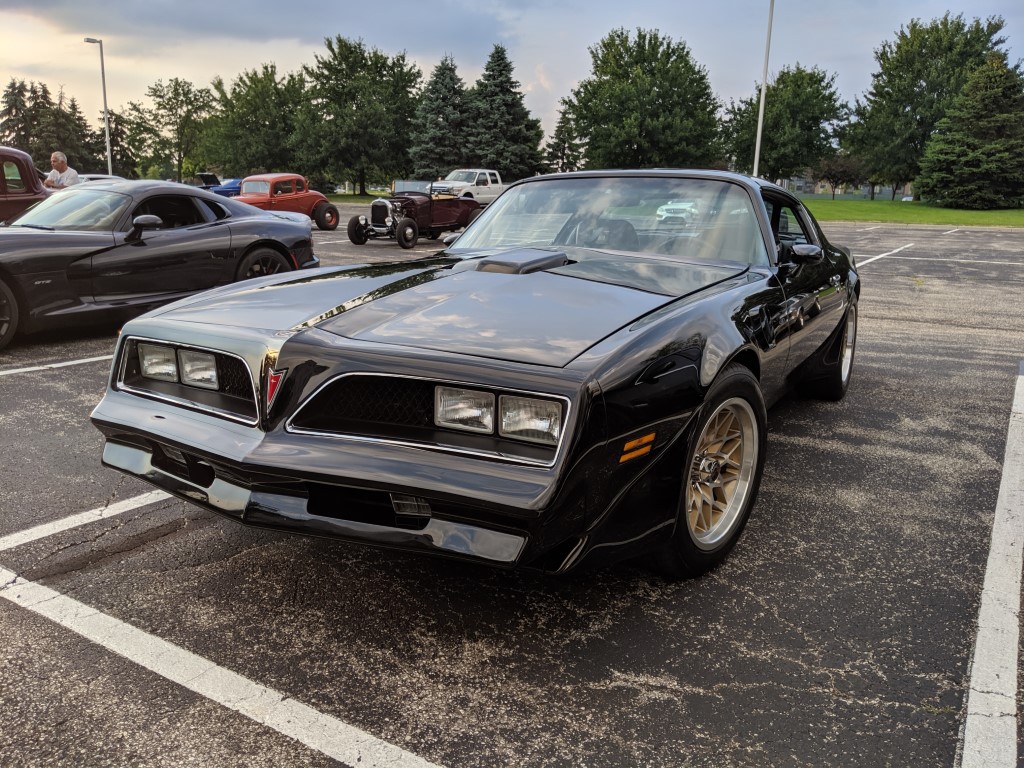
Project Trans Am – 18 Months Later

So I’m now 18 months into my 1981 Pontiac Trans Am project and things are just now starting to come together. From April – July I really didn’t get to spend much time on the car, our new baby was coming (born June 27th) and preparing for/having him took precedence! I even had to neglect the lawn a couple weeks in July, luckily none of my neighbors complained.

Sand Blasting and Exhaust Manifolds – Blast Cabinet Blues

In August I worked on the small rusty parts for the motor. I sand blasted the exhaust manifolds before painting with Eastwood Exhaust Manifold Gray. I even purchased my own sand blasting cabinet similar to the ones sold by Summit/Jegs, but quickly discovered what a pain in the butt it is to own your own blasting cabinet. After 2 weekends using it, I decided I was better off going over to my buddy’s place rather than trying to turn my garage into a body shop. The blast cabinet I got was a table top model. Though it was technically big enough for my exhaust manifolds, it really was too small to work in, I had to open the cabinet every time I wanted to turn the manifolds to blast other sides. Perhaps if I ever had a larger garage I would get a bigger blast cabinet, but it’s just not practical for the garage I have now.

Once I got the manifolds painted, my buddy Joel baked them in his industrial oven. They came out exactly how they went in! I am pretty impressed with the Eastwood exhaust paint and will try some of their other paints in the coming months.

I also got all the other engine brackets and small parts to my core support blasted and painted.

Engine Painted and Freeze Plugs Installed – CAM PLUG ISSUES!

Painting the block and all the other parts was a labor of love. I now know why most engine builders recommend putting the engine together before painting, because it is a pain figuring out what should and should not be masked off! I figured it out though, and it sure looks good! I used Dupi-color engine paint  DE1616 Pontiac Blue Metallic. The machine shop painted the heads already with this color, so I just had to paint the block, timing cover, oil filter housing, oil pan and water pump.

I then installed the freeze and oil gallery/galley plugs. Last was the rear cam plug. This is where things went bad. The Federal-Mogul freeze plug kit I got for my Pontiac 400 came with the wrong size freeze plug. Because I had to re-install the rear oil plug a second time, I purchased a 2nd Federal-Mogul freeze plug kit, and it also came with the wrong cam freeze plug. Luckily i was looking at the cam plug in the 301 block I had (luckily I didn’t get rid of it yet) and looked at photos of other freeze plug kits and discovered the problem was with the depth of the plug. I also discovered that NAPA Auto Parts sells individual freeze plugs! So the 3rd time around I got the exact cam plug size I needed and for less than $1.50 too!

The Pontiac references I have all say the plug needs to be .03″ deep from the “lip”. The cam plug packaged by Federal-Mogul is itself just over .04″ deep, so when installed, it went in too far. With the shallow cam plug with a depth of .02″, the plug installed correctly and the cam test-fit fit without hitting it.

I learned a few things with the cam plug issue. First is I’ll never buy a Federal-Mogul freeze plug kit for a motor ever again! NAPA rocks when you’re in a pinch. Third is te importance of test fitting all the parts.  I wasn’t going to test fit the cam until I talked to my friend Tim who recommended test fitting everything and re-measuring all the tolerances of the bearings and plugs. Had I not test fitted the cam, I would have gotten much further into the build before discovering the problem, at which point would have made it a lot harder to remove and replace! Last important thing I learned is next time I’m going to buy everything from the Machine shop. I maybe saved $100 by buying everything from Summit/Jegs, but the headaches from some parts working and some not’ is not worth the savings.

Rings Filed, Rear Main Seal, Cam, Crank and Pistons Installed – ALL BUT 1 PISTON!

In September I somehow found time to file fit all my piston rings, install the rear main seal, crank, and cam! I spent one weekend just test fitting everything and using plasti-gauge to verify everything fit correctly. I actually discovered I was using the wrong main bearings in the wrong saddles during the process. Plasti-gauge is a tedious process, I never used the torque wrench so much before that weekend! IF your not familiar, you need to install the crank dry with all the bearings in and only test one bearing at a time. So if your tests go smoothly, you’re only doing this 5 total times. Unfortunately I did this 7 times because of the bearing miss-hap. After everything was said and done, all the bearings are at .002″. I also did this for all the connecting rod bearings, they are also at .002″. For the rod bearings I Was able to use a bore gauge. My bore gauge wasn’t big enough for the crank bores, so I had to use the plasti-gauge.

Rear main seal install went smoothly using a Viton rear seal. In the photo you can see it lines up perfectly, except one end came out a little bit. When the crank is installed, it presses in where it needs to be. I don’t see how this motor could leak, but time will tell!

Before I installed the crank for the final time, I installed the cam. Its a lot easier to install a cam with the crank out. Once I got the cam and crank installed, I started installing the pistons. After getting the first 2 pistons installed as pictured, I discovered that I had 5 pistons tops of one valve relief design, and 3 the other valve relief design. This stopped me in my tracks, as I should have 4 and 4 of each type. I’m now waiting for the machine shop to get the new piston top in and swap the rods. I’ve since installed the remaining pistons, so all but piston 8 are installed, torqued and ready to go.

Firewall and HVAC

In October I Decided to repaint the firewall so it would have that fresh/new look under the hood. There wasn’t any rust to worry about, and only a couple spots where there was bare metal to worry about priming, but getting all the little parts off the firewall took a lot of time. Removing the wiper motor and assembly was a monster. Once I figured out how to remove these little clips underneath the wiper arms, things started to come apart smoothly. I also removed all the seam sealer from the top of the cowl as it was pretty dried out and cracked. The seam sealer on the sides did not look bad at all, so there must be something about seam sealer being exposed to water longer that may be why it was in worse shape. Either way, scrapping and cleaning that off was a bear. Once the cowl and the firewall were clean, I did my usual prep work  (scuff with fine 3m pad and clean with paint thinner), taped off areas I didn’t want paint, and then went to work with fresh paint. I used Rustoleum Satin Black 7777. It’s not the best paint, but it’s not the worst either. Since this was going over existing paint, I wasn’t as worried about it getting damaged by drops of brake fluid someday.  The firewall turned out quite nice.

I’m also in the process of rebuilding the HVAC box. Confusing at first, Ive pretty much figured out how the entire AC/Heat system works! it’s quite interesting how much of the duct work baffles and doors require engine vacuum in order to open/close. I’m also surprised someone hasn’t figured out how to replace all this stuff with modern actuators/valves tat run on electric motors. Either way, I’m almost done rebuilding mine, just waiting on a new Actuator for switching from AC to heat (kind of important). I am installing an AC Delete panel on the firewall, but the AC option is still necessary if I want to use the vents to blow air.

Degreed Cam

My buddy Joel came over a couple weeks ago and helped me degree my Crower 60918 cam. If you’re familiar with Pontiac cams, this cam is very similar to the popular 068 cam, kind of in-between a 068 H.O. cam and a Summit 2801 cam. With the timing chain straight up the cam is at 107 degrees, really close to the recommended 108 degrees. One thing I did learn though was the importance of a good cam degree kit. I got one of those universal Summit degree kits, which worked, but a motor specific kit made by Comp Camps would have made things so much easier. Next time I degree a cam, I’m getting the Pontiac engine specific Comp Camps degree kit, as it comes with a special crank socket that the degree wheel attaches to and has the specific dial indicator attachment for connecting to a Pontiac block.

Fan shroud

The fan shroud came with a very large crack, on the top of all places. I sourced another used one that would work in the short term when I decided to research if I could repair the current one. After doing some reading I found a post that explained why glue’s typically do not work, and the best thing to do is to melt the plastic back together with a soldering iron. So with my crappy soldering iron I did just that and it worked! The stitch (if you want to call it that) looks anything but desirable though, but it works. I was thinking about running filler of some sort over it, but after spending 30 minutes sanding the plastic I decided to leave it and call it a day. I then scuffed up the rest of the fan shroud, cleaned it then threw on some Krylon Fusion plastic flat black paint. I also painted some of the intake parts and the cowl vent at the same time. It came out pretty nice!

Special Thanks!

I have to give special thanks to my friends Joel and Tim for their help this summer! With all the little complications I’ve had, I’ve almost wanted to give up and hand the motor off to a mechanic to put together for me. Their confidence and expertise helped me keep going! Thanks guys!

I also have to thank my wife for letting me spend so much time in the garage. Thanks babe!

What’s Left

If I don’t run into anymore snags and the machine shop gets me the correct piston top in the next week, I should be able to get the rest of the motor assembled, front frame painted with Eastwood’s Chassis Black and get the motor installed in the car. Hopefully by December I’ll have the cam broken into and most of the car back together!


The Sears/Kmart dot com = Horrible Commerce Sites and Craftsman made over seas?

First let me clear the air, the sears.com / kmart.com (And all other domains it takes itself on as) are horrible sites for web commerce. Also troubling is the trend to manufacture Craftsman hand tools over seas.

Searching for Craftsman Tools on a Mobile Device

Searching for Tools on sears.com with a mobile device is nearly impossible. First, the search on the mobile site is terrible. Second, most of the content is not there. The worst part is there is no way to switch from the mobile site back to the regular site. Hint: iPhone and Android based phones don’t need a mobile site. I usually prefer the regular site on my iPhone or Android phone 99% of the time.

My alternative method of finding stuff on sears.com from my mobile device is to search Google. Well, guess what, when you navigate to the link, the sears.com site refreshes to a mobile version of the same page, which in most cases does not exist because the mobile site doesn’t have all the content as the main site.

What can Sears do to improve this situation? They can add a link at the bottom of the mobile site to allow users to switch to the regular one.

Why should they do this? Because it can make the difference of a customer coming to the store or not. Last thing I need is going to a store to find they don’t sell what I’m looking for.

Intermingling of Products on Sears.com that are not sold by Sears

First, if you’re not aware, many of the items on sears.com are not sold by Sears. Let me be clear what I am saying, there are items on sears.com not sold by Sears or companies that are part of Sears like Kmart or the Great Indoors. There are products on sears.com sold by other, competing businesses. Why does Sears sell their web real-estate to other businesses? My only guess is that someone pitched the idea to be like “Amazon.com” at a board meeting but didn’t think it through. Unfortunately, someone didn’t explain the Amazon.com model very well to the sears web developers, and what you end up with is a web site that pulls away customers from Sears to other vendors. Signs of an Amazon.com model would include products that are shipped and processed by Sears, with Sears products featured first. Quite the opposite, it appears non-Sears products get priority in search, and worse yet they compete against Sears in number of ways.

Further harming Sears, there appears to be a glitch in Sears’ web application as non-Sears businesses are capable of selling identical Sears merchandise, and those items are featured over the same items sold by Sears, even if Sears has the lowest price on the item. Take the following example:

Craftsman 7 Piece Standard Nutdriver Set (link). As of this writing, this 7 piece set costs 112.83 and is sold by “OnlineSuperSeller” (not Sears). When you search Sears.com for “Craftsman nutdriver”, you get the following results (as pictured) with the 2nd and 3rd results being Craftsman nut drivers listed at nearly 4 times their normal retail price.

After some additional searching, I finally found the product I was looking for (link). Though the Craftsman part numbers are different, the 4-5 digit number is not something I refer to when I look for products. Incidentally a search for “nut driver” with the space in between the two words has completely different search results.

Production Dilution

The web site is diluted by products that compete with their own line of products. For example, when you go to a Sears store, they have 1-2 alternatives to Craftsman Tools (Evolv Sears economy line of tools and GearWrench. Online you have even more brands, most of which again are not sold by Sears or affiliated companies.

Different Prices on Different Pages

When you do the search for “nut driver” and find the nut driver set in question, it will be priced 26.99. When you go to the actual product’s page, the price changes to $29.99. I am sure many customers get this far, see the price change, then immediately leave the page. Those that swallow the price increase and add the item to the cart, they will magically see a $3 discount to the item, bringing the price back to 26.99. Unfortunately, how many customers is Sears loosing when the customer changes their mind when the price changes?

Non-Intelligent Search

The search system for normal (not mobile) Sears and related web sites is horrible. Take for example, a search for “Craftsman Combination wrench set”. The first 2 results are a couple of combination sets, 6 point wrenches, which is good, but then to find more combination wrench sets, you need to brwose beyond the rest of the first 25 results to find more sets. I shouldn’t see individual wrenches when I search for “sets”.

To add insult to injury, the search box does not keep what you last entered, which means if your search isn’t giving you the results you want, you have to re-type everything in.

Craftsman Tools no longer made in USA

I don’t necessarily have a problem with tools being made all over the world, but I do have a problem with the current trend at Sears/Craftsman to move previously made in USA tools off-shore. At first I was not concerned because it appeared obvious that the “Evolv” line (priced accordingly) are made over seas while the traditional Craftsman and Craftsman Professional tools are made in the USA. The price difference between Evolv and Craftsman reminds you that your paying for quality tools made by your own fellow citizens. The first sign of Craftsman tools no longer being made in the USA was when I purchased one of the new Craftsman Dog bone wrenches. When I got home I was surprised to see “made in China” stamped on it. At that point I accepted the idea that perhaps new tools will be made over-seas. More interestingly, the Harbor Freight dog-bone wrenches are identical to the Craftsman dog-bone wrenches.

More recently I’ve been shopping for a set of flare wrenches. When I looked at the Craftsman Professional flare wrench set, I discovered they are now made over seas. This scares me, because over the past 20+ years I’ve been purchasing Craftsman hand tools, usually priced 2-3 times more than their import counterparts, with the satisfaction that I was buying a quality tool made in the USA. I have no problem paying a premium knowing the money I spend is paying some tool makers salary somewhere in the country. If someone told me back in 1993 that in 20 years from now the tools you buy will no longer be made in the USA, I wouldn’t have bought them. I’m not questioning quality of the tools, I have some tools from Harbor Freight made in China and they’re great. My issue is with what I thought the brand represented, and apparently I was wrong.

Again, new or specialty tools made over seas with a Craftsman logo on them I can understand. I have a vintage (made in the 70′s-80′s) Craftsman Distributor wrench 9/16″ #47755 that’s made in Japan. Craftsman no longer makes the wrench, most likely because cars no longer have distributors, so it was a smart move on their part not to invest on the tool and die here in the states for such a tool. But the idea of the core hand tools no longer being made in the USA yet still having the premium pricing bothers me.

Lowes just recently completed their transition to a made over-seas tool line,  and I’ve made a point never to buy Kobalt tools. If I find out the traditional Craftsman wrenches and hand tools are produced over seals then Craftsman will go on my “never buy list as well”.

By the way, if you are looking for USA made tools, try Wright Tool (made in Barberton, Ohio!), Williams (division of Snap-on), or Masterforce (a Menards brand, not all Masterforce tools are USA made, but most are).

My Thoughts

Sears has a lot of brands with brand recognition built up over many years that is now negatively impacted by a poorly executed web site and possibly poor decision making on where some of their items are made (Craftsman no longer made in USA). Though I love going into a Sears store when shopping for Tools, between the web site making it difficult for me to make the decision to go to the physical store and the fact that the product brand I seek now has issues that trouble me, I find it harder and harder to pick going to a Sears store over my local Walmart, Home Depot, Lowes or Menards.

What can Sears do to fix the problems? Stop meddling with the Craftsman line and put out a press release guaranteeing that their tools will remain made in USA. Stop trying to be like Amazon, and use their web site to re-enforce sales at your local stores. Physical stores should use their web sites to reinforce sales at the stores, making the web site compete with the stores is just a bad business practice in my opinion, unless your plan is to eventually close all the stores. Fix the search system by adding better product descriptions, incorporating product importance weights and creating special search algorithms for different departments (e.g. a Tool finding widget). Keep pricing consistent, if you show a price on a web page, make sure the same price appears on all other pages. I would take down the mobile site and only replace it when developers use the same database and infrastructure as the regular site  and include the ability to go back to the regular site.

Pegboard in the Garage and Snags Tearing Down the Pontiac 301 Turbo


PegboardThis Memorial Day weekend I got to do some work around the house. My initial plan was to start building the Pontiac 400, but I recently discovered I needed one more part (Cam thrust plate) and it did not arrive yet, so I decided to work on the firewall and other various little parts on the Trans Am. After spending about an hour in the garage moving stuff around, I decided to switch my car project to a Garage improvement weekend. By Monday I installed 64 square feet of pegboard and enough hangers/hooks to get just about everything shy of 15 pounds off the garage floor.

On Monday I started work on tearing down the Pontiac 301 Turbo. If you’re not familiar with the Pontiac 301 Turbo, it was made in 1980 and 1981 for the Pontiac Trans Am and Formula making it a rather rare engine. Some say it was ahead of it’s time, others say it was plagued by it’s oil cooled turbo charger. It was the last true Pontiac designed V8. What ever your thoughts on this short lived engine are, once I confirmed that my Trans Am was not a special edition, I decided to swap it out with a Pontiac 400. Since last fall this V8 has been sitting in the garage just taking space. This weekend I decided it was time to take it apart to see what was wrong with it and recycle what ever parts that can be reused. Believe it or not, this engine shares a lot with it’s larger cousins (350, 400 and 455) such as engine mounts, fuel pumps and the bell housing.

During the initial tear down I ran into a couple snags. First was the flywheel bolts having 12 point heads. My plan was to use my compressor with the impact wrench attached. My plan went foul once I discovered that the impact sockets I got with my compressor are all 6 point. A run to the neighborhood home improvement stores showed me how rare 12 point impact sockets are. I do understand that a 6 point socket is better for 6 point bolt heads and that’s most likely why the 12 point impact sockets are hard to find, but come on, someone has to sell 12 point impact sockets! When you’re dealing with a 12 point bolt head, you can’t use a 6 point socket.

So after doing some online shopping, I found that only a handful of tool companies make such sockets. Sadly most all of these sockets are through brands like Snap-On, which make the tools too expensive for a weekend mechanic like myself. I did find a set of 12 point SAE impact sockets on Amazon.com that meets my price range. (see picture). They also have 12 point metric impact sockets.

The second snag working on the 301 Turbo came when I made a rookie mechanic mistake! I am using an engine leveler for lifting the motor, that way I can easily level the engine with the engine hoist/cherry picker. I recall today reading somewhere “Always connect engine levelers and engine hoist chains using grade 8 bolts to engine heads. Avoid connecting to bell housing or aluminum intake manifolds when possible“. Well I learned yesterday the hard way why you don’t connect your engine hoist to the bell housing! When I got ready to bolt the engine to the engine stand, you can guess the colorful language that came out of my mouth! Lesson learned the hard way, never never NEVER ever use the bell housing when lifting an engine!


Torque Wrenches Reviewed

I’m currently in the process of rebuilding a Pontiac 400 v8. The process has led me to buy a lot of new tools. Most of these new tools aren’t too expensive, such as a dead blow hammer and piston ring compressor. The one tool for this project that is quite an investment is a good torque wrench.

I already own Craftsman beam type torque wrenches and a Harbor Freight 1/2″ drive torque wrench. They worked well for the little things I’ve needed to torque down, but decided that they are not up to par for an engine rebuild. Thus my torque wrench research started.

Testing Torque Wrenches

Around Christmas I got an Alltrade 940759 Powerbuilt Digital Torque Adaptor. It comes with what they call a calibration cube, it’s a square chunk of metal for your vice that has a 1/2″ square hole machined into it to plug your torque adapter into. The Adaptor can be used as a torque wrench, but it is better used as a way to test the calibration of your torque wrenches. I took it over to a buddies place and we tested his torque wrenches (he had a small click-stop that measures in inches and a larger click-stop that measures in pounds, I believe both are from AutoZone). We found that placement where you held your hand on the torque wrench effected the measured torque as much as +/- 10 pounds depending on where you had your hand on the handle. Essentially we learned that you want your hand exactly where the manufacturer tells you to hold it, and you want most of the force to be applied along your index finger and thumb so the force you apply is placed exactly where the torque wrench expects it.

The following weekend I tested my torque wrenches (I have a 1/2″ 0-150 ft. lb beam style Craftsman, a 3/8″ 0-75 ft. lb beam style Craftsman, and a 20-150 ft. lb. click-stop Harbor Freight) and found them all to be very accurate. With the beam wrenches, you need to be able to read it straight on, any angle and you were reading 5-10lb over/under. The beam style wrenches have special handles that pivot exactly where you want all the force to be applied, so there was no issue of hand misplacement like the click-stop type. The click-stop from Harbor Freight however, was not as accurate counter clockwise as it was clockwise. The Harbor Freight, though accurate, was not precise and would click anywhere between +/- 3 ft. lb. when torquing tests of 75, 100 and 125 ft. lbs. This is within the advertised +/- 4%.

Precision and Accuracy

There is a difference between precision and accuracy. Accuracy is when you’re within a certain range consistently. Precision is when you hit the same measurement every time. You can be precise without being accurate, e.g. you set your torque wrench for 100 ft lb and it constantly stops at 110 ft. lbs, your precise, but it’s not accurate. To be both precise and accurate is the end goal.

What to Look For

When buying torque wrenches, there are details you need to look for.

  • Does it meet industry standards? (e.g. ASME B107.14M-1994, ISO 6789)
  • What do other folks say about the wrench
  • Type of torque wrench (beam, click-stop, split-beam, dial, digital)
  • What is the accuracy +/- in what percent of the range

The type of torque wrench is important based on how you plan on using the tool. I prefer the beam style simply because they are very reliable, you can rely on the beam to be accurate every time and they typically never need calibrated. The only down side is you need to be able to read the wrench straight on. The click-stop are the most popular, but their accuracy and precision is heavily focused on the manufacturer of the wrench. The split-beam are excellent wrenches as well that will not need calibration as often as a click-stop, but they only torque clockwise, which could be a problem depending on what you want to do. Dial type wrenches are expensive. Digital torque wrenches are great, but most are priced beyond what we can afford.

The accuracy in what percent of the range was one item that took me a while to put my head around. Basically, a torque wrench will have a range e.g. 10-100 ft. lbs, and in most of that range it is accurate. Typically the torque wrench makers call this it’s accuracy percent range.  All the wrenches I narrowed my results down to have  upper 80% range accuracy. What this means is that the first 20% of the range of the torque wrench may not be within the advertised +/- accuracy.  In the case of a 10-100 ft. lbs torque wrench, this would mean that from 10lb to 28lb the wrench may not be as effective. I suspect the lower range is not as accurate because of the low tension being applied to internal springs. With this accuracy range in mind, it may be ideal to have multiple torque wrenches to cover specific ranges.

Narrowed the Results Down

In January, I discovered there are quality wrenches under $150 if you know where to look. Here’s a quick outline.

  • CDI Torque Wrenches (Maker of the Snap-on torque wrenches) can be purchased online for a great deal less than their Snap-On counterparts. The Best thing is, they don’t hide the fact that they are a division of Snap-on. Wrenches are made in USA.
  • Precision Instruments Split Beam (maker of the Snap-on Split-Beam specific wrenches) wrenches can be purchased online for a great price as well. Split-beam are less likely to ever need calibration, but one downside is they only torque clockwise. Wrenches are made in USA.
  • GearWrench and KD Tools (divisions of Danaher Tool Group, who also make torque wrenches for Sears Craftsman) have well made torque wrenches for the money.  Torque wrenches are made in USA.
  • Brown Line Metal Works BLD0212 Digital Torque Wrench is a new torque wrench that is the only digital wrench that fits within the budget. It is a new wrench from a new company, regardless I believe they have a pretty reliable design.  I talk further about this torque wrench at the bottom of this post. Wrench made in Malaysia.

What I Purchased

Based on all the different ranges each torque wrench advertises, I decided to purchase two wrenches.

CDI 1002MFRMH 3/8″ drive 10-100 ft. lbs: I would say this is the best designed torque wrench I’ve had in my hands to date. Changing the torque amount is easy and the wrench definitely feels like a precision tool. I plan on using this for torquing bolts between 30-100 ft. lbs.

GearWrench 85054 1/2″ drive 25-250 ft. lbs: Also well designed torque wrench, adjusting the torque setting is just as easy as the CDI model, but it doesn’t quite feel as precise as the CDI, though still in the same quality class as the CDI. The long length of the wrench makes it easier to apply torque. I plan on using this for torquing bolts between 75-250 ft. lbs.

Both the GearWrench and the CDI are both accurate and precise when I tested with my Digital Torque Adaptor, both clockwise and counter clockwise. I was unable to test the GearWrench beyond 147 ft lbs due to the limitation of the Digital Torque Adaptor. They are both excellent torque wrenches.

The BrownLine Digital Torque Wrench

This wrench really interests me. I tried to contact the manufacturer to see if someone sells the wrench locally and received no response. I did do some research and found the patent they filed for the wrench. I also found from an Ebay seller that the wrench is made in Malaysia.

When I reviewed the patent, I quickly figured out what they did. Essentially the BrownLine torque wrench is a beam-style wrench with a microprocessor that translates the beam measurement to digital. This essentially solves the issue with reading beam wrenches at an angle. Remember the beam style wrenches don’t go out of calibration unless the actual beam itself is broken. By reason, this wrench should last a very long time. Aside from the microprocessor, there’s not much with this wrench to go wrong. Had I been able to see one of these wrenches in person, I may have purchased one.

Conclusion

If you have the money, the Snap-on torque wrench is definitely a quality tool. If you are on a budget like me, the CDI torque wrenches (which are essentially Snap-on torque wrenches without the logo on them) are a real bargain. If you want a torque wrench you never have to worry about calibrating or torquing counter clockwise, the Precision Instruments will fit the bill nicely. If you’re on a really tight budget, The GearWrench torque wrenches are the best value priced on the market.

If you have a Brown Line digital torque wrench, please leave a comment and tell me what you think of it.

My Enthusiasm for Pontiac Continues

Trans AmIf you’ve talked about cars with me in recent months, you know I’m in the process of restoring a 1981 Trans Am. I bought the car knowing the motor needed rebuilt or replaced. Last fall I picked up a Pontiac 400 V8 (more specifically, a W72 from a 77 Trans Am with the transmission and carburetor, the W72 is arguably the last great V8 designed by Pontiac engineers).

Since about October, I’ve been doing a lot of research on Pontiac V8′s built from 1955-1982, as well as other research specific to the mid to late 1970′s Firebirds. I quickly found that I have about 30 significant web sites I now visit to read about Pontiac engine specifics, as well as about a dozen or so vendors who sell Pontiac specific parts. I also have accumulated over 200 bookmarks. the process has lead me to become rather frustrated. There’s lots of great information, but it’s all over the place and no one has a really good site map to all of these sites. Out of this frustration I am going to launch a new web site that will link to everything I’ve bookmarked. Stay tuned for an official announcement when the site is launched.

Aside from the Pontiac site-map web site I have planned, I’m also going to launch a video podcast of all the work I do on the car. Expect an announcement on that sometime this month as well.

The Details

My original plan was to freshen up the 400 I picked up last fall and drop it into the Trans Am. After stripping the top end of the motor down I discovered a lot of rust in the top of the heads and a lot of sludge in the oil pan. At this point it became obvious I would need to tear the motor down further.

In October, I finally got the motor further apart and found a lot of carbon build-up on the pistons, and I also found during the break down that an exhaust manifold stud was broken inside of the drivers side head. I reluctantly decided then I needed to take at least the heads to a machine shop. After further dis-assembly, I decided it would be worth the money to have the motor completely rebuilt.

I decided to take the heads, block and crank to Kauffman Racing Equipment located here in Ohio. They did a great job and kept me updated through the entire process.

Over Christmas I got a few books and a video on engine rebuilding. After reading the books and watching the video I decided that I (Yes I) will rebuild this motor myself! I was able to take it apart, I should be able to put it all back together, right? Following this decision, I’ve done the following:

  • Researched and purchased torque wrenches (I will have a detailed post about my research in the coming months)
  • Researched and purchased other specific tools (caliper, feeler gauge, bore gauge, plasti-gauge)
  • Researched and purchased specific books on Pontiac V8′s made from 1955-1979 (there is not much documentation for the last 3 years of Pontiac v8′s unfortunately)
  • Researched and purchased books on the Rochester Quadrajet carburetor
  • Took a welding class where I learned how to stick and MIG weld
  • Research specifics to the Pontiac V8 (350, 400, 455 cubic inch family specifically)

Last week I picked up my block, heads and crank from the Kauffman Racing and boy they look great. I have new pistons, new rods, a turned crank, 400 block bored .030 over , and new stainless steel valves and springs on 6x-4 heads. Oh, and the crank, rods and pistons have been balanced as well. Based on a compression calculator, I estimate the new compression of this motor is somewhere between 8.3:1 to 8.5:1. The head gasket I end up using will be the final determining factor of compression. Either way, 8.5:1 is ideal, that way I can run unleaded gas from any gas station in the country.

The Pontiac Community is Awesome!

I’ve met some pretty cool car guys that have been very helpful through the project. I will say that the stereotype that many folks associate with 70′s muscle car owners could not be further from the truth. It’s a pretty diverse crowd of car enthusiasts from all walks of life. What has surprised me is how many younger folks younger than I are 100% into the hobby. Another common trait seems to be hard work and dedication, which appears to not only show in their love of Pontiac but also in their careers and family life. What blows my mind is how GM not only failed to capitalize on this passion for the brand over the past years, but they completely turned this community away when they ended Pontiac.

What’s Next

The next 2-3 months will include rebuilding the motor, painting the engine bay, fixing the turn signal and the T-tops. Hopefully by summer she’ll be on the road!

Stay tuned, I’ll be posting pictures of the motor soon.

Garage is Finished!

This weekend got the garage walls painted. I went ahead and primed + painted the wood framing around the garage door as well. Only 1/4 of the garage hasn’t been painted, that’s the corner that already had drywall along the back/side walls along the house.

I had 2 little electric heaters running in the garage over the weekend, which maintained a 65 degree temperature in the garage for 24-28 hours after I painted to help it dry. One electric heater got the garage to about 50-55 degrees but couldn’t go beyond that without the help of a second heater.

Next weekend I’ll be re-hanging hooks, a new cabinet and the wheel barrel on the walls so there’s even more garage floor space (Heather can get her parking spot back).

Garage Door Insulated

The weather here in Ohio since Thanksgiving is not cooperating with my garage insulating project. So I can finish painting the garage, I need to get the garage door insulated. I considered using 2 garage door kits for my 16 foot wide door, but decided after reading reviews and considering the cost (over $150) that I should find another solution. I decided to get 1 1/2″ thick foamboard from my local Home Depot. The foam board came with a plastic tape on one side, and metallic material on the other wide. With the test piece I got, I discovered that it worked perfectly jammed between the upper and lower rails of a garage door section (see picture). I had to cut a vertical relief cut for each section of foam board that way the fit is very tight. I sealed each relief cut with a strip of matching aluminum tape.

I did this the first weekend of December. The following day I sanded the drywall to prepare it for paint. I only spent about half an hour sanding, and it still filled the garage with white dust. Next week comes the paint!

Garage Drywall Up

The Garage Drywall is up (Actually was up the weekend before Thanksgiving. The mud work was done the weekend after Thanksgiving, which took a long time since I’ve never done it before. Right about when I finished I finally think I got the hang of it.

Last step is to sand and paint.

Two Years with Google Android G1 – Looking for a Replacement

It has been well over 2 years since I got my HTC G1 with Google Android. The verdict? It has done it’s job, but it’s now showing it’s age. Running Android 1.6, I’m limited to which apps I can install. The lack of internal memory storage is also a problem, I’m finding myself uninstalling other apps I like just so I can keep Google Maps up to date. It’s time to upgrade for sure.

Reflecting on past posts One year with Google Android G1 compared to 6 months with an iPhone 3GS and Google Android G1 Week 2 Review, you can get a good idea of my opinion of the phone. I love the thing. Hardware wise, I love the keyboard. The software interface is excellent. Apps available, awesome. The latest apps and Android OS though have left the G1 behind, which is forcing me to upgrade.

I’ve been looking for a replacement for 6 months now. I really like the 3.7″ and 4″ screen models, and the processors the latest models come with in even the value priced Android phones function ten times better than my aged G1. So why haven’t I purchased a replacement? None have quite the same layout and feel. All the new phones with qwerty keyboards tend to use keys that are square with hard to feel edges. Sure, they are nice to look at, but is no solution if you’re used to typing without looking down before you start typing.

Potential Replacements

All of the replacements I’m considering have at least a 3.7″ screen, Android 2.1 or newer, a qwerty keyboard, and at least 4MB of internal storage.

Sprint’s Epic 4G – My first choice at this point, I find the keyboard the most friendly, though still not like the G1.

Pros:

  • larger 4″ screen
  • I like the Keyboard
  • 4G support
  • Rumors are there is Sprint 4G service in Columbus Ohio
  • 10GB internal storage
  • Night minutes start at 7pm

Cons:

  • Most expensive phone I’m considering
  • Does not have Android 2.2 (though it’s rumored to be coming soon)

T-Mobile’s G2 – My second choice, this phone would be a decent replacement.

Pros:

  • I can stay on T-mobile.
  • Keyboard is ok
  • 4G support (no 4G in Columbus Ohio though)
  • Adobe Flash support
  • Android 2.2

Cons:

  • Not confident that the keyboard flip out design is going to last 2 years

Verizon’s Droid 2 – I almost don’t want to consider this phone, but since it’s on Verizon, I am considering it since my wife is also on Verizon and we could switch to a Family plan.

Pros:

  • Cheapest model, you can find this phone for less than $100 with a 2 year contract
  • 8GB internal storage
  • Android 2.2

Cons:

  • I don’t like the keyboard at all
  • No visual voicemail without paying more money to Verizon

Unless something changes, I think I’m going to go with the Epic 4G. Rumors are it will have Android 2.2 this December, which is really the deciding factor for me since I’ve grown tired of the G1 because it is not getting anymore OS updates. I think I’m going to wait a couple more weeks to see if the Epic 4G gets Android 2.2. If it doesn’t, I think I’ll give the G2 a try.

Which Android phone do you suggest I upgrade to?

Garage is Insulated!

We got the insulation up in the garage this past weekend. My dad came down to help me (Thanks Dad!). Caulking and sealing holes/cracks took the bulk of our time. Putting up the insulation took maybe 3 hours once we got into a rhythm. We used 7 rolls of 40′ by 15″ R-13 faced insulation, three tubes of caulk, and 2 cans of Great Stuff foam.

This weekend we’re putting up drywall. I got lucky yesterday and bought the last carpenters 4 foot drywall square from Harbor Freight, which should make our job sizing the drywall easier.

I’m still trying to decide how to insulate the garage door. Lowes and Home Depot sell kits, but they seem overly priced compared to using sheets of polystyrene insulation sheathing (foam board). What would be perfect is a way to put the sheets of polystyrene foam board into the sections of the garage door then cover that with a flexible 16′ x 8′ sheet of white vinyl that will bend with the door when it opens and closes. Please leave comments if you have thoughts on this.